Guidelines
Help Shape the Direction of the Cancer Detection Guidelines for Firefighters!

Calling all firefighters, caregivers, health professionals, and policymakers!
The International Agency for Research on Cancers, part of the World Health Organization, has found that working as a firefighter can increase the risk of cancer.
In response, the Government of Canada passed Bill C-224. This bill created a national plan to raise awareness about cancers linked to firefighting and to improve access to prevention, screening, and treatment.
As part of this work, Health Canada selected McMaster University’s Cochrane Canada and GRADE Centre to develop guidelines for cancer detection in firefighters. We will develop about 20 recommendations, based on the best available research, to support decisions about cancer detection in firefighters.
Now, we want to hear directly from you.
What is the survey about?
Because cancer detection includes many possible actions – such as education, screening, diagnosis, and system changes – the project needs a clear focus.
We are launching a short research study to gather input from firefighters, caregivers, health professionals, and policymakers, on the most important topics and questions for cancer detection guidelines.
Your feedback will help us focus on what matters most and prioritize what these guidelines should cover. From all suggested questions, about 20 will be selected to develop the final recommendations.
Your feedback will help ensure the guidelines are practical, relevant, and useful for clinical practice and decision-making, ultimately supporting better health outcomes for firefighters. Participation in this survey is entirely your choice. It will not affect your employment, access to services, or professional standing.
Who can take the survey?
Health professionals, firefighters, caregivers, or policymakers aged 16 and older who have an interest in cancer detection for firefighters.
Where can I complete the survey?
Access the survey: here
How long will it take?
Estimated completion time: 15 minutes
When will the survey close?
The survey will close on July 27th at 11:59 PM EST.
What are the possible risks and discomforts?
Taking part in this survey has very little risks. However, there may be questions related to work-related cancer that may cause some people to feel upset or uncomfortable.
Who can I contact for questions?
For questions regarding the survey or the guideline project, please contact our team at gradeadm@mcmaster.ca.
This research study has been reviewed by the Hamilton Integrated Research Ethics Board under Project #19882.
Will there be other opportunities to get involved?
Yes! To learn about future opportunities to get involved with the guidelines, sign up for the McMaster Cochrane Canada and GRADE Centre newsletter here.
Share our survey on social media!
• Facebook
• LinkedIn
• X
• BlueSky
Launching New Guidelines for Cancer Detection in Firefighters

The Canadian Guidelines and Resources for Cancer Detection in Firefighters (CAN-CDF) will produce the first national evidence-based recommendations for cancer detection in firefighters.
Funded by Health Canada and led by the McMaster University Cochrane Canada and GRADE Centres, the project launching in 2026 will: 1) develop living recommendations addressing multiple cancer types relevant to the firefighting profession, 2) produce and disseminate information sheets and tools on how to use the recommendations, and explainer videos for use by health care providers and firefighters, and 3) evaluate the uptake of the recommendations and these tools.
Guideline Process and Timelines
| Year 1 | - Define priority topics and questions for recommendations - Select guideline panel and form working groups - Consult interest holders and develop and disseminate materials to raise project awareness - Project kick-off meeting |
| Year 2 | - Conduct systematic reviews on cancer detection - Continued consultation with interest holder groups - Develop ‘living’ recommendations |
| Year 3 | - Maintain and update living recommendations as needed - Develop knowledge translation tools (plain language recommendations, decision aids, training materials) - Disseminate guidelines through continuing medical education, webinars, and outreach |
| Year 4 | - Update living recommendations and finalize the guidelines - Evaluate guideline uptake and use of knowledge translation tools |
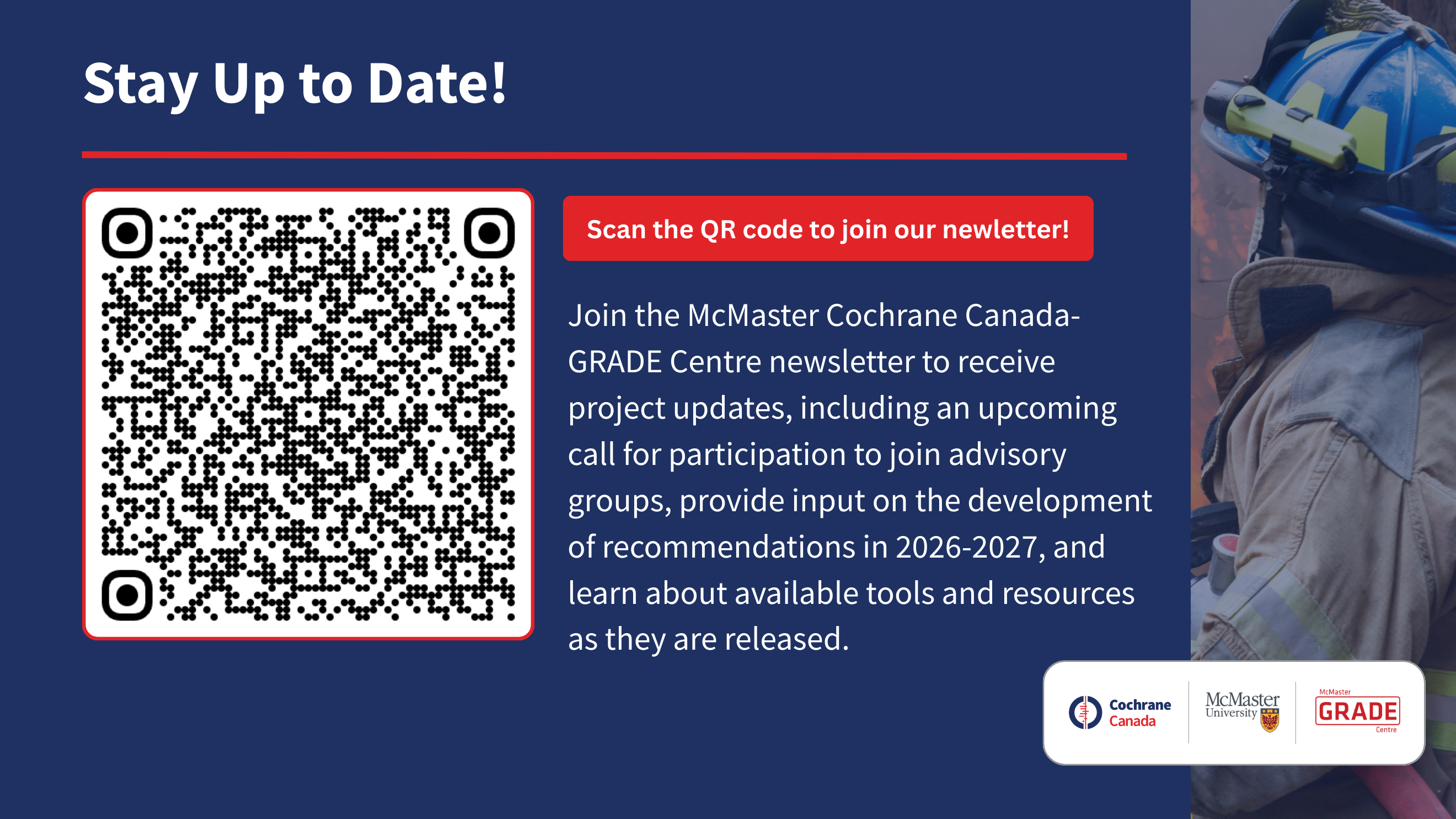
Stay Up to Date!
Join the McMaster Cochrane Canada GRADE Centre newsletter (here) to receive project updates, including an upcoming call for participation to join advisory groups, provide input on the development of recommendations in 2026-2027, and learn about available tools and resources as they are released.